Journal · 10 Sep 2026
Carhartt WIP Alternative: Built Different, 2026 Guide

Table of Contents
- Quick Comparison: Carhartt WIP Alternative Picks
- What Makes a Real Carhartt WIP Alternative?
- Durable Streetwear Brands That Don't Cut Corners
- Premium Workwear Hoodies Built for the Grind
- How to Style Workwear for the Street
- Pricing Breakdown: What You Actually Pay For
- Conclusion
- Frequently Asked Questions
Last Updated: September 10, 2026
Quick Comparison: Carhartt WIP Alternative Picks
Finding a real Carhartt WIP alternative comes down to one thing: whether the garment holds its shape after a year of hard wear, not whether it photographs well on day one. At PJR Built Different, we build heavyweight cotton for people who actually work in it.
Here's the short version before the details:
| Pick | Fabric Weight | Price | Best For |
|---|---|---|---|
| PJR Built Different heavyweight hoodie | 271 g/m² fleece | NOK 383.50 | Cold shifts, daily grind |
| PJR Built Different premium heavyweight tee | 220 g/m² ring-spun cotton | NOK 162.50 | Everyday base layer |
| PJR Built Different garment-dyed long sleeve | 207 g/m², garment-dyed | NOK 279.50 | Layering, lived-in colour |
The heavyweight hoodie is the one most people start with. It's the piece that survives a twelve-hour service and still looks right on the walk home.

What Makes a Real Carhartt WIP Alternative?
A genuine Carhartt WIP alternative is a garment built from heavyweight, pre-shrunk fabric with reinforced seams and honest construction, not a logo printed onto a thin blank. That's the whole test. Everything else is marketing.
Three things separate a real alternative from a costume:
- Fabric weight. Under 200 g/m² and it's a fashion tee, not workwear.
- Construction. Double-needle stitching, twill-taped shoulders, side-seamed bodies.
- Shrinkage control. Pre-shrunk cotton that still fits after the tenth wash.
Norwegian Consumer Authority guidance on textile labelling and care claims
Durable Streetwear Brands That Don't Cut Corners
Durable streetwear brands earn the label through fabric density and stitch count, not through heritage storytelling. When you're comparing options, look at the spec sheet before the lookbook. Most guides skip this part, so here it is in plain terms.
The g/m² number is a starting point, not the whole story. A 220 g/m² ring-spun tee and a 220 g/m² open-end tee can feel completely different after ten washes. Ring-spun yarn is combed and twisted tighter, so the surface is smoother, the loop is denser, and the neckline resists the stretch that turns a crew neck into a scoop. Open-end yarn is cheaper to produce and pills faster at the underarm and hem. If a brand lists weight but not yarn type, that's a tell.
Knit structure decides how the garment ages. Single jersey is the standard tee knit, light, breathable, and prone to twisting at the side seam if the fabric isn't relaxed before cutting. Side-seamed construction (rather than tubular) lets the body panel be cut on-grain, which is why a side-seamed tee hangs straighter after a year. Look for it on the spec sheet; it's one of the clearest quality signals in the category.
Collar construction is where cheap tees die first. A 7/8" topstitched or twill-taped collar holds its shape because the tape reinforces the seam that takes the most stress when you pull a tee over your head. Flat, single-stitch collars stretch out within a season. This is the single fastest way to sort a durable tee from a disposable one on a rack.
Shrinkage control is a construction decision, not a wash instruction. Pre-shrunk or garment-dyed cotton has already been through the stress that causes a 5-8% shrink in untreated fabric. If a brand doesn't state pre-shrunk or garment-dyed, assume the fit you try on is not the fit you'll own in three months.
Our Men's premium heavyweight t-shirt sits at 220 g/m² with a single-needle edge stitch and a side-seamed fit. The Men's heavyweight short sleeve t-shirt is the daily-service version: high stitch density, reinforced seams, built to be worn every day rather than saved for occasions.
Norwegian Consumer Authority guidance on textile labelling and care claims
Premium Workwear Hoodies Built for the Grind
Premium workwear hoodies are defined by fleece weight and stitch reinforcement, and the benchmark most people should look for is roughly 270 g/m² and up. Below that, a hoodie is a layer for mild weather, not a piece of kit. But weight alone doesn't tell you how a hoodie will behave after a season of daily wear, the fibre blend and the rib construction do most of that work.
Cotton-poly vs. all-cotton fleece. A 50/50 cotton-poly blend holds its shape and resists pilling better than 100% cotton fleece, because the polyester adds memory to the loop. All-cotton fleece feels softer on day one and breaks in more dramatically, but it also sags at the cuffs and hem faster if the rib isn't built properly. Neither is wrong, they're different tools. If you want a hoodie that looks the same in month twelve as month one, blend. If you want one that fades and softens into something personal, all-cotton.
The hood is where cheap hoodies expose themselves. A double-lined hood with a matched drawcord holds its shape when you pull it up and doesn't collapse into a flat flap after a few washes. Single-layer hoods with a thin drawcord look fine on a hanger and fail in the rain. Check whether the drawcord matches the body fabric weight, a flimsy cord on a heavy hoodie is a sign the brand cut corners where you can't see it.
Rib recovery is the long game. 1×1 rib cuffs and waistband with a small percentage of spandex (typically 2-5%) will snap back to shape after being stretched over hands and hips hundreds of times. Rib without spandex stretches out permanently. This is the single most common failure point on a hoodie that otherwise looks well-made.
Fit across body types. Heavyweight fleece has less drape than lighter knits, so a boxy cut on 271 g/m² fleece reads as structured rather than slouchy. If you're between sizes and want a relaxed look, size up, the fabric won't collapse into the extra room the way a lighter hoodie would. If you want it to sit close, stay true to size; the weight holds the shoulder line without pulling.
The Men's heavyweight hoodie is our answer to that standard: 50/50 cotton-poly fleece at 271 g/m², a double-lined hood with a matched drawcord, and 1×1 rib cuffs and waistband with spandex so the shape recovers instead of sagging. Double-needle stitching runs throughout. It lives on the pass, in the car, and on the walk home.

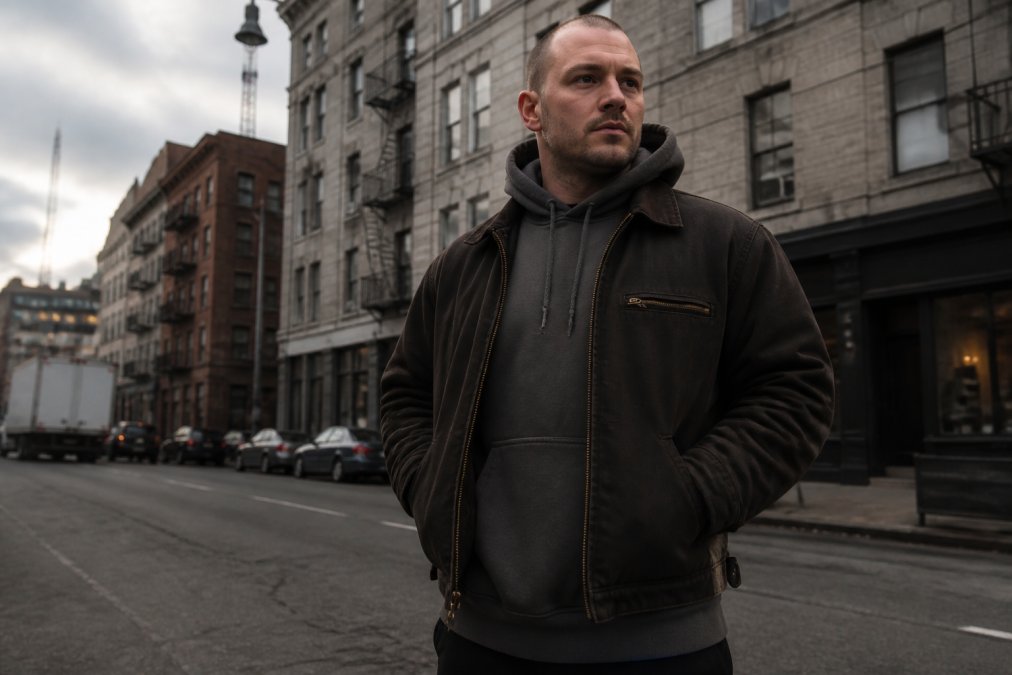
Where it falls short: it's a pullover, so if you want a full-zip you'll need to look elsewhere. We built it the way kitchen work actually demands, and nobody's reaching for a zip mid-service.
How to Style Workwear for the Street
Styling workwear for the street works best when you keep the palette tight and let the fabric weight do the talking. Workwear reads as authentic when the proportions are honest and the pieces look worn-in rather than styled.
A simple formula that holds up:
- Heavyweight tee as the base, tucked or untucked
- Garment-dyed long sleeve over it when it's cold
- Hoodie on top, not under, a jacket
- One cap, no more accessories than that
The Men's garment-dyed heavyweight long sleeve is the layering piece here. Because it's garment-dyed after the sew, the colour sits deep in the fibre and fades the right way over time instead of going patchy. The Embroidered dad hat finishes it: cotton twill, low-profile, embroidered mark rather than a printed one that cracks.

Pricing Breakdown: What You Actually Pay For
Price in this category tracks fabric weight and construction, not brand name. A tee that costs more usually costs more because it uses heavier cotton and more stitching, and that's the part you can verify.
| Garment | Fabric | Price |
|---|---|---|
| Heavyweight short sleeve tee | High-density cotton knit | NOK 193.70 |
| Premium heavyweight t-shirt | 220 g/m² ring-spun cotton | NOK 162.50 |
| Garment-dyed heavyweight tee | 207 g/m², garment-dyed | NOK 214.50 |
| Heavyweight long sleeve | Heavyweight ring-spun cotton | NOK 227.50 |
| Garment-dyed long sleeve | 207 g/m², garment-dyed | NOK 279.50 |
| Organic oversized tee | Heavyweight organic cotton | NOK 352.50 |
| Heavyweight hoodie | 271 g/m² fleece | NOK 383.50 |
The honest answer to "what am I paying extra for" is the fabric and the stitch work. We have no investors and no shortcuts behind the label, so the money goes into the garment rather than a campaign. Two decades in professional kitchens taught us what falls apart and what doesn't.
Norwegian Institute for Consumer Research on textile durability and purchasing
Conclusion
The hard part isn't finding a Carhartt WIP alternative. It's finding one that still fits and still looks right after a year of real wear, because most of what's sold as premium workwear quietly isn't. PJR Built Different builds heavyweight cotton garments with pre-shrunk fabric, reinforced seams, and construction that holds its shape through the grind. Start with the heavyweight hoodie or the premium heavyweight tee and see what a garment built by people who've done the work actually feels like. Contact us and gear up for the long haul.
Frequently Asked Questions
What brands are similar to Carhartt WIP?
Several brands occupy the same space: durable streetwear that borrows from workwear without the mass-production feel. Look for labels that prioritize heavyweight cotton, reinforced stitching, and a clear point of view. PJR Built Different is one example, built on 20+ years of kitchen experience with no outside investors. The key is finding brands that treat construction as non-negotiable, not an afterthought.
What should I look for when choosing a durable streetwear hoodie?
Check the fabric weight first. Anything under 250 g/m² won't hold its shape through daily wear. Look for double-needle stitching at stress points, a double-lined hood, and ribbed cuffs with spandex so they don't stretch out. Pre-shrunk fabric matters too, it means the hoodie you buy is the hoodie you keep. PJR Built Different's heavyweight hoodie hits 271 g/m² with all of these details.
Are there streetwear brands that prioritize craftsmanship over fast fashion?
Yes, but you have to dig past the hype. Independent brands without investor pressure tend to care more about what happens after the sale. Look for transparency about materials, specific fabric weights listed on product pages, and a brand story that explains why the clothes exist. If a brand can't tell you the g/m² of its hoodie, it's probably not built for the grind.
How do independent workwear brands compare to mainstream labels?
Independent brands often offer heavier fabrics, better stitching, and a fit designed for actual bodies doing actual work. If you want a hoodie that survives a full year of daily wear, considering independent brands can be a good option.
Editorial Team