Journal · 16 Sep 2026
How to Prevent Graphic Print Peeling: 2026 Care Guide

Table of Contents
- Why Graphic Print Peeling Happens (And Why Cheap Prints Fail Fast)
- How to Wash Graphic Tees to Prevent Fading and Peeling
- Best Practices for Drying Screen Printed Shirts
- How to Stop Hoodie Collars Stretching (And Keep the Whole Garment in Shape)
- How to Fix Peeling Prints With an Iron, Parchment Paper or Heat Gun
- Ink-Type Identification: Why Plastisol, Water-Based and DTG Prints Age Differently
- Storage, Rotation and the Professional Repair Call
- Conclusion: Treat the Print Like It Cost You Something
- Frequently Asked Questions
Last Updated: September 16, 2026
Why Graphic Print Peeling Happens (And Why Cheap Prints Fail Fast)
Graphic print peeling is the failure of the ink layer to stay bonded to the fabric, and it almost always starts long before you notice the first crack. This guide from PJR Built Different breaks down exactly how to prevent graphic print peeling, whether you're washing a heavyweight tee or a screen printed hoodie.
The bond between ink and cotton is mechanical, not magical. Plastisol ink sits on top of the fabric and locks into the weave when it's cured at the right temperature. Skip that step, or rush it, and the print never fully anchors. Water-based ink soaks into the fibres and cures thinner, which makes it softer but less forgiving of abuse. Direct to garment printing sprays ink onto the surface, so it depends even more on proper pretreatment.
Here's what most care guides get wrong: they blame your washing machine for everything. The real killer is heat plus abrasion, repeated over and over. A print that survived a cheap cure will still fail if you tumble dry it on high for six months straight.
How to Wash Graphic Tees to Prevent Fading and Peeling
Washing graphic tees correctly comes down to three things: turn them inside out, use cold water on a gentle cycle, and never let bleach near them. Get those right and you've eliminated most of the damage before it starts.
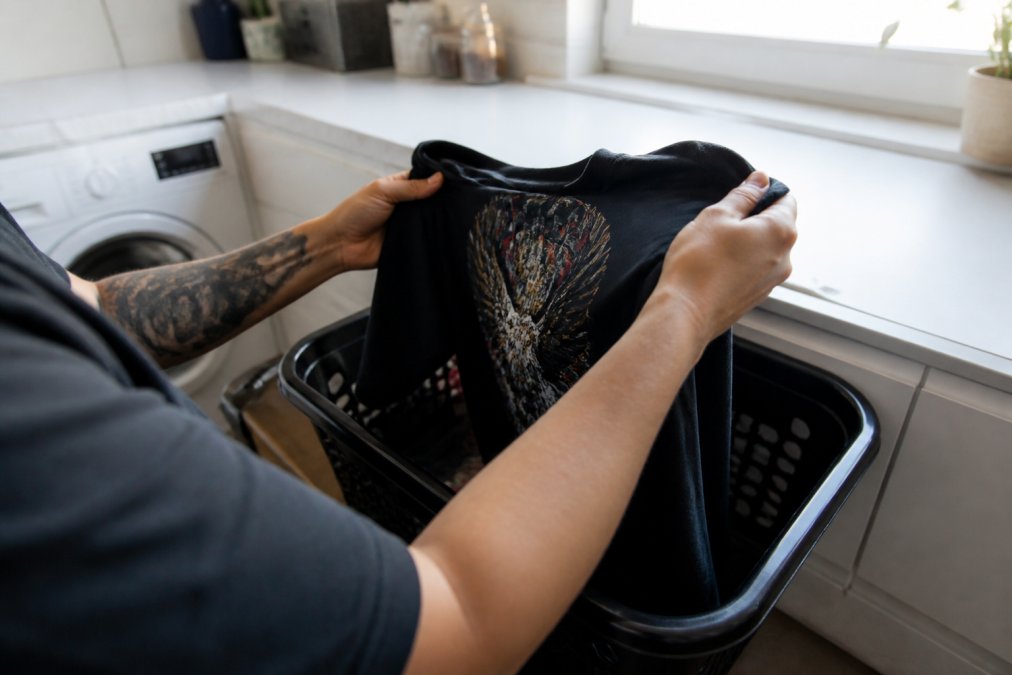
Turn It Inside Out Before It Hits the Drum
Flipping the shirt inside out puts a layer of cotton between the print and everything else in the load. That matters because fabric abrasion is what physically grinds ink off the surface, especially against zippers, denim, and other rough items.
- Turn the garment inside out and check the print isn't folded onto itself
- Zip up hoodies and close any velcro before washing
- Wash graphic tees with similar fabrics, not heavy workwear
- Keep the load loose so items aren't grinding against each other
Cold Water, Gentle Cycle, and the Detergent You Should Never Touch
Cold water wash protects print adhesion because heat softens the ink and weakens its grip on the fibres. A gentle cycle reduces the mechanical agitation that causes cracking over time.
Skip bleach entirely. It attacks both the dye in the fabric and the chemistry holding the print down. Powder detergents with harsh fillers can also leave residue that dulls the print surface. A liquid detergent without bleach works fine for everyday loads.
Best Practices for Drying Screen Printed Shirts
Air drying is the single best thing you can do for a screen printed shirt. Tumble drying on high heat is the fastest way to crack, fade, and distort a print you actually care about.
Air Dry vs. Tumble Dry: What the Heat Actually Does
Heat does two damaging things at once. It softens the cured ink so it stretches and separates from the cotton, and it shrinks natural fibres, which pulls the print in directions it wasn't designed for. That combination is what produces the classic cracked, flaking look.
| Drying Method | Effect on Print | Best For |
|---|---|---|
| Air dry, flat or hung | Preserves adhesion and colour | Every graphic tee and hoodie |
| Tumble dry, low heat | Slower wear, some risk | When you're short on time |
| Tumble dry, high heat | Fast cracking and fading | Never for prints you value |
Hang drying in shade also protects against UV rays, which fade pigment over time even when the print stays intact. If you must use a machine, choose the lowest heat setting and pull the garment out slightly damp.
How to Stop Hoodie Collars Stretching (And Keep the Whole Garment in Shape)
Stretched hoodie collars usually come from two habits: yanking the garment off by the neck, and hanging it wet by the hood. Both put constant tension on the collar seam, and once that seam relaxes, it rarely comes back.
The fix is mechanical, not chemical:
- Pull hoodies off by the shoulders, not the collar
- Never hang a wet hoodie by its hood or collar
- Dry flat or drape over a wide bar to spread the weight
- Fold and store instead of hanging heavy cotton for long periods
Keeping the whole garment in shape matters because a distorted hoodie drags the print with it. When the body stretches, the graphic stretches, and that's when you start seeing hairline cracks at the edges of the design.
How to Fix Peeling Prints With an Iron, Parchment Paper or Heat Gun
You can often re-bond a lifting print at home. The method depends on how far the peeling has gone and what ink you're dealing with.
Men's premium graphic t-shirt →
For a light lift, place parchment paper over the print and press with an iron on medium heat, no steam, for 15-20 seconds. The parchment stops the ink sticking to the iron plate.
When to Use a Chemical-Based Sealant Instead
Chemical-based sealants are a real option for prints that have lifted across a large area, not just at the edges. These products soften the existing ink so it re-adheres to the fabric, which makes them useful when heat alone won't reach the whole design.
Ink-Type Identification: Why Plastisol, Water-Based and DTG Prints Age Differently
Knowing your ink type tells you how the print will age and how much care it needs. Plastisol sits on the surface and is the most durable under washing, which is why it dominates screen print production. Water-based ink soaks in and feels softer but fades faster. Direct to garment printing bonds ink to the surface with pretreatment, making it the most sensitive to heat and abrasion.
Here's how to tell them apart without a lab:
- Plastisol: thicker, rubbery feel, sits clearly on top of the fabric
- Water-based: print feels like part of the shirt, slightly muted colour
- DTG: fine detail, no raised texture, often on lighter garments
Ink-Type Identification: Why Plastisol, Water-Based and DTG Prints Age Differently
Knowing your ink type tells you how the print will age and how much care it needs. Plastisol sits on the surface and is the most durable under washing, which is why it dominates screen print production. Water-based ink soaks in and feels softer but fades faster. Direct to garment printing bonds ink to the surface with pretreatment, making it the most sensitive to heat and abrasion.
Here's how to tell them apart without a lab:
- Plastisol: thicker, rubbery feel, sits clearly on top of the fabric
- Water-based: print feels like part of the shirt, slightly muted colour
- DTG: fine detail, no raised texture, often on lighter garments
Storage, Rotation and the Professional Repair Call
Storage won't fix a bad cure, but it slows the decline. Fold graphic tees rather than hanging them, keep them out of direct sunlight, and avoid stacking heavy items on top of a print. UV rays fade pigment even in a closet if light reaches the fabric.
Norwegian Standards for textile durability and care
Conclusion: Treat the Print Like It Cost You Something
Most people wreck their graphics through carelessness, not bad luck. Cold water, inside out, air dry, no bleach. That's the whole game.
Frequently Asked Questions
Why is my print on my T-shirt peeling off?
Most peeling comes down to heat and abrasion. Hot wash cycles, tumble drying on high, and harsh detergent break down the bond between the ink and the cotton fibres. On lower-quality prints, the curing process was rushed at the factory, so the ink never fully locked in. Once the edges lift, friction in the drum speeds up the damage. Cold water, gentle cycles and air drying remove the two biggest causes and can add years to a print that would otherwise crack within months.
Is it possible to fix a graphic print that has already started peeling?
Yes, if the print is lifting at the edges rather than flaking away in chunks. Place parchment paper over the graphic, set your iron to medium heat with no steam, and press for 15 to 20 seconds. Let it cool before peeling the paper back. For stubborn spots, a heat gun on low held 10 to 15 cm away works, but keep it moving or you will scorch the cotton. A chemical-based sealant is the last resort for prints that have lost their adhesive layer entirely.
Does high-heat drying damage screen-printed graphics?
It does, and faster than most people realise. Tumble drying on high exposes the print to sustained heat that softens plastisol ink and stresses the bond with the fabric. Over repeated cycles, the print cracks along fold lines and the edges curl. Air drying on a rack, or a tumble on low heat for 10 minutes to knock out wrinkles followed by hanging, keeps the print intact. If you must use a dryer, take the shirt out while it is still slightly damp.
How should I store premium streetwear to prevent print cracking?
Fold, do not hang, graphic tees and hoodies for long-term storage. Hanging puts stress on the shoulders and stretches the collar over time. Stack folded garments in a dry drawer or shelf away from direct sunlight, since UV rays fade both the print and the base fabric. Avoid vacuum bags and tight compression, which crease the print along hard fold lines. Rotate your rotation so no single piece sits compressed for months, and keep hoodies zipped or buttoned to hold their shape.
Editorial Team